Oral Taxi Test Prep Course
The course covers all the key areas you’ll be tested on, including taxi safety checks, conditions of use with regards to passenger pickups, and common offences. Each topic is explained clearly and in line with what examiners expect, helping you understand not just the answers, but how to explain them confidently in the oral mechanic test.

Conditions for Taxi in Mauritius
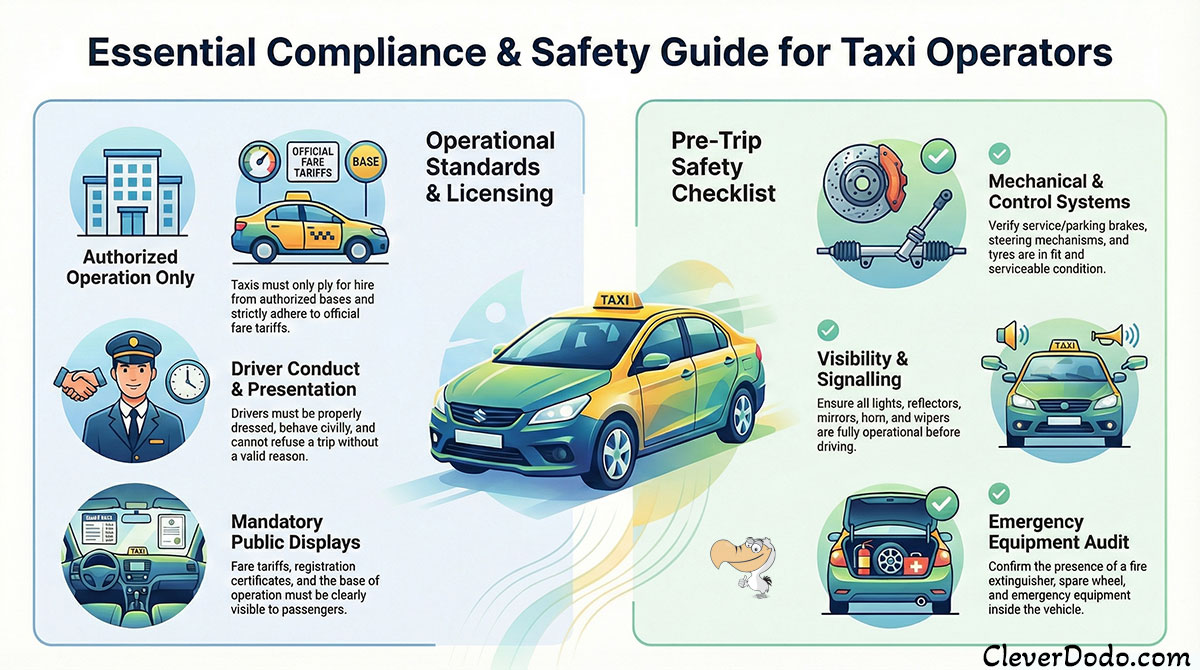
This guide is a roadmap for those wishing to become taxi drivers, and is designed to transform the official regulations in Mauritius into a clear, easy-to-understand set of principles. Mastering these rules is the first and most crucial step toward building a successful career, providing excellent service, and ensuring the safety of yourself and your passengers.
# Signage and Display
Your taxi is your office, and its appearance speaks volumes about your professionalism. Regulations ensure that every taxi is clearly identifiable and provides customers with essential information, both inside and out.
The Official Look: Essential Signage
Your vehicle must be immediately recognizable as a licensed taxi through specific external markings:
- Yellow "TAXI" Roof Sign: A yellow sign featuring the word "TAXI" in black lettering must be affixed to the roof or roof rack of your vehicle. To ensure visibility, this sign must be illuminated at all times between sunset and sunrise.
- Front Door Information: Both front doors of the taxi must clearly display the vehicle's authorized base of operation and its service number in the manner prescribed by the authority.
Clarity for Your Customer: In-Cab Information
Transparency is key to building passenger trust. The following information must be clearly displayed inside the vehicle at all times:
- Tariff of Fares: The official fare chart is non-negotiable. Copies of the current tariff must be printed in bold characters, placed in a suitable frame with a transparent plastic cover, and securely fixed on both of the sun visor near the front left seat beside the driver's in such a manner as to be readily visible to passengers.
- Registration Certificate: Your official Registration Certificate must be displayed inside the taxi where it is clearly visible to passengers throughout the duration of operation. This certificate is your proof of legal operation.
- Driver & Taxi Register: You are required to keep a register in the vehicle that details the particulars of the taxi itself and any authorized part-time driver. This is an essential record for compliance.
Just as your vehicle must present a professional image, so too must you, the driver.
# The Driver's Code: Conduct, Licensing, and Operations
Your license is a privilege that comes with significant responsibilities. How you conduct yourself, manage your license, and serve the public are the cornerstones of your career.
Professional Conduct: The Core Principles
Your behaviour and appearance directly reflect on the service you provide. Always adhere to these two fundamental principles:
- Personal Presentation: The driver must be properly dressed and clean at all times.
- Manner: The driver must behave in a civil and orderly manner.
Your License to Operate: Key Rules
Your taxi license is governed by strict conditions designed to ensure it is used actively and for its intended public service purpose.
Rule Consequence/Condition License Usage Failure to use the license for more than six months without a valid reason may lead to its revocation. Public Benefit Failure to use the license for the benefit of the public may lead to its revocation. Driver Residency The driver must live in the locality where the vehicle is licensed to operate. Main vs. Part-Time Driver The person holding the license is considered the main driver and must inform the authority of any part-time drivers. License Transfer If a license is transferred to another person, the original holder is debarred from receiving another one in the future.
Service Obligations: The Passenger Comes First
As a public service provider, your primary duty is to the passenger.
You are not permitted to refuse a trip requested by a passenger without a valid reason. Furthermore, your taxi is only authorized to operate for hire from its official, authorized base of operation.
Your professional conduct is paramount, but it means nothing without an unwavering commitment to safety.
# Safety First: Your Pre-Trip Ritual and Essential Equipment
The most important part of your day happens before your first trip. A thorough pre-trip inspection is a non-negotiable daily routine that ensures the safety of you and every person who rides in your vehicle.
The Daily Pre-Trip Inspection Checklist
Before driving, you must make sure your vehicle is in good working order. This includes a full mechanical check and an inspection of the interior for any damage that could affect passenger comfort or safety. Critically, remember the specific safety belt regulation: if your driver's seat has a safety belt, you must always use it for safety when driving without any passenger.
- [ ] Service brakes (including hydraulic pipe)
- [ ] Parking brake
- [ ] Steering mechanism
- [ ] Lights and reflectors
- [ ] Tyres
- [ ] Horn
- [ ] Windshield wiper or wipers
- [ ] Rear-vision mirror or mirrors
- [ ] Wheels and rims
- [ ] Emergency equipment
- [ ] Access doors
- [ ] Taxi car Interior
Required On-Board Equipment
You must be in possession of, or have in your vehicle, the following documents and equipment at all times:
- Driving licence
- Yellow chalk
- Agreed statement of facts (for accidents)
- Fire extinguisher
- Spare wheel
- Tools
- Motor vehicle licence
- Insurance vignette
- Fullmer (A term often referring to a specific type of logbook or meter; confirm the exact requirement with the authority.)
- Part time taxi tools and equipment (You must seek clarification from the licensing authority on the specific items this regulation entails.)
- Fitness certificate
With these rules and safety checks in mind, let's test your understanding by answering a few common questions.
# Core Knowledge Check: Answering Common Questions
How do you identify the base of operation for a taxi?
The authorized base of operation is required to be fixed on both of the taxi's front doors.
Who is allowed to drive a taxi?
Only the main driver (the licensee) or an authorized part-time driver who possesses a Registration Certificate issued by the National Transport Authority is allowed to drive the taxi.
List five conditions attached to a public service vehicle.
- The vehicle must be maintained at all times in a fit and serviceable condition.
- The driver must strictly adhere to the official tariff of fares, which must be displayed inside the cab.
- The vehicle’s Registration Certificate must be displayed inside and be clearly visible at all times.
- The driver must always be properly dressed, clean, and behave in a civil and orderly manner.
- The driver shall not refuse to perform a trip for a passenger without a valid reason.
What is the first thing you should do before starting your journey in the morning?
The first thing you must do is conduct a thorough pre-trip inspection of the vehicle. This is to ensure the taxi is in good and safe working order before you begin driving.
What are the general safety driving rules that apply to a taxi driver?
The core safety rules involve three key areas:
- Vehicle Readiness: You must ensure the vehicle is mechanically safe by performing a daily pre-trip inspection of critical components like brakes, steering, tyres, and lights.
- Emergency Preparedness: You must carry all required safety equipment, including a fire extinguisher, a spare wheel, and tools.
- Personal Safety: You must adhere to the safety belt rule: if your seat is equipped with one, you must use it when driving without any passengers.
NOTE: For more lessons like this, check out our oral taxi test course.
Oral Taxi Test Prep Course
The course covers all the key areas you’ll be tested on, including taxi safety checks, conditions of use with regards to passenger pickups, and common offences. Each topic is explained clearly and in line with what examiners expect, helping you understand not just the answers, but how to explain them confidently in the oral mechanic test.
Course Information