Oral Mechanic Bus Test Prep Course
The course covers all the key areas you’ll be tested on, including bus safety checks, braking systems, correct gear use, as well as drivers’ regulations, conditions of use, and common offences. Each topic is explained clearly and in line with what examiners expect, helping you understand not just the answers, but how to explain them confidently in the oral mechanic test.

Correct Use of Gears in a Bus
As a new bus driver, learning to handle your vehicle on challenging terrain can feel intimidating, but it's one of the most rewarding skills you can develop. Mastering gear changes is the key to unlocking superior vehicle control, safety, and confidence, especially on hills and curves. Think of driving as a partnership with the laws of physics; you're constantly managing forces like gravity and momentum. Your gearbox is the primary tool you have to manage them effectively and stay in complete command of your vehicle.
The "Why": Understanding the Forces That Shape Your Drive
Before we dive into the "how," it's crucial to understand the "why." Understanding a few key physical forces is the first step to becoming a more intuitive and proactive driver.
Gravity: The Invisible Hand on Hills
Gravitational force is the constant pull that all objects experience towards the centre of the earth. On a flat road, its effects are minimal, but on a hill, it becomes a major factor you must manage. It's also important to remember that gravity, when combined with your momentum, helps create the traction that is essential for steering through a curve or bend.
- Going Uphill: Gravity works against your vehicle's forward motion. It actively tries to pull you backward, which slows you down and requires the engine to generate more power to continue the climb.
- Going Downhill: Gravity works with your vehicle, pulling it down the slope. This will naturally increase your speed, sometimes to a dangerous degree, making speed control an essential part of a safe descent.
Momentum and Inertia: The Power of Planning Ahead
Momentum is the force of a moving object, generated by its speed and weight. The faster and heavier your vehicle is, the more momentum it has. To put this in perspective, the momentum force of a motionless vehicle weighing 2,000 kg is zero, but at just 10 km/h, it generates an additional force of 1,000 kg. Increase that speed to 30 km/h, and the momentum force jumps to a massive 4,000 kg. This shows how quickly speed makes your vehicle much harder to stop or turn.
Closely related is inertia, which is the tendency of an object to resist changes in its motion. For a driver, this means your vehicle wants to continue traveling in a straight line. This is why navigating a curve requires you to apply active control to change the vehicle's direction.
Centrifugal Force: The Outward Push on Curves
When you steer your vehicle through a bend, you feel a force pushing you to the outside of the turn. This is centrifugal force. It is the tendency of your vehicle to be pulled outward, effectively trying to continue in the straight line dictated by inertia. This force is your primary opponent when navigating a curve, and managing it is critical for maintaining stability.
Friction (Traction): Your Grip on the Road
Friction, which we call traction in driving, is the grip your tires have on the road surface. This essential force is created by the weight of the vehicle pushing the tires down onto the road. Good traction is what allows you to steer, accelerate, and brake effectively. Maintaining it is the foundation of vehicle control, especially on hills and in curves where other forces are trying to destabilize the vehicle.
Now that you understand the forces at play, let's look at how to use your gears to manage them effectively.
The "When": General Rules for Shifting Gears
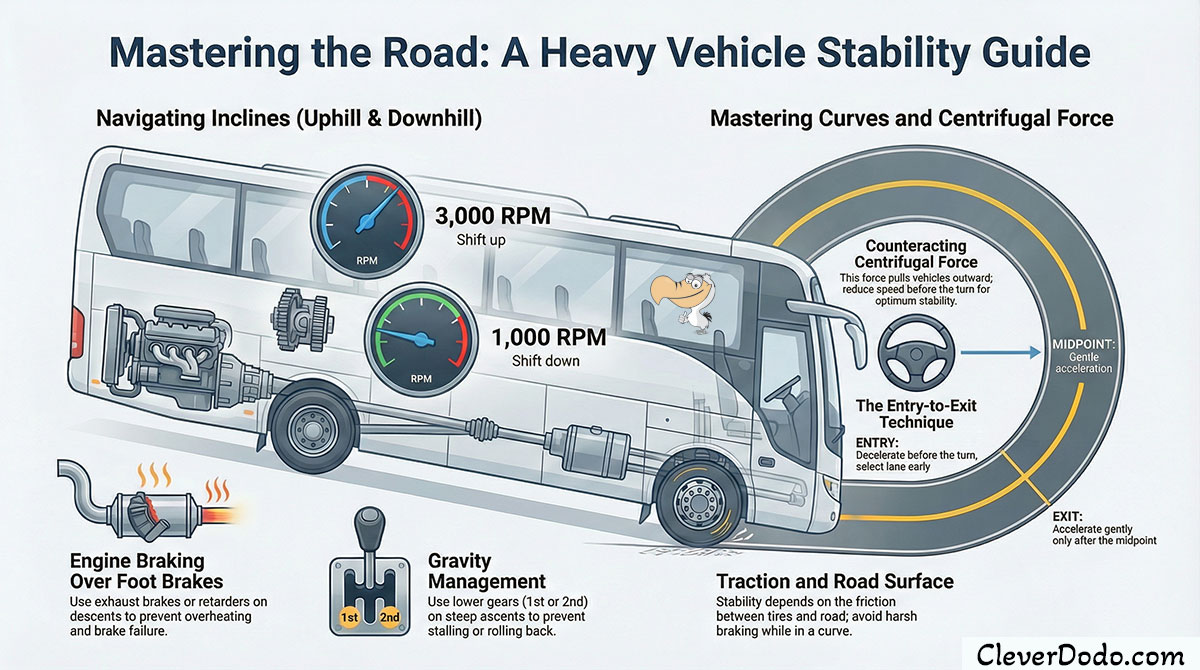
Knowing when to shift is a skill you develop by sight and sound. The tachometer, which measures engine speed in Revolutions Per Minute (RPMs), gives you a clear visual cue.
Action Tachometer Reading (RPMs) Shift Up Around "3" or 3,000 RPMs Shift Down Around "1" or 1,000 RPMs
Beyond watching the gauges, you must also listen to your engine. If it begins to roar, whine, or struggle, it's giving you a clear signal that a downshift is needed quickly. Don't hesitate. To prevent stalling or overheating, depress the clutch, shift to second gear, and then accelerate as you release the clutch. This ensures you have the power you need for the situation ahead.
With these basic rules in mind, let's apply them to the three most common challenging situations: uphill, downhills, and curves.
Tackling the Climb: How to Shift Gears Uphill
Why You Must Downshift for Ascents
When you drive uphill, you are in a constant battle with gravity. To win this battle, your engine needs to deliver more power to the wheels. Shifting to a lower gear (like first or second) is necessary to give the vehicle the mechanical advantage it needs to climb the slope at a safe and constant speed.
The Dangers of the Wrong Gear
Attempting to climb a steep hill in too high a gear (like fourth or fifth) is not only ineffective but also dangerous.
- Loss of Control: The engine will not have enough power and may stall or "caroter"—a term for labouring heavily. This will cause the vehicle to lose speed dangerously and create the risk of rolling backward.
- Vehicle Damage: Forcing the engine to struggle in a high gear under such a heavy load can cause serious damage to its internal components.
Uphill Driving: A Step-by-Step Checklist
- As your vehicle begins to slow down or you hear the engine start to struggle on the incline, prepare to downshift.
- Select a lower gear appropriate for the steepness of the hill (first or second gear on very steep ascents).
- Maintain a constant and gradual acceleration to drive the vehicle safely and smoothly up the slope.
- A good rule of thumb is to use the same gear to go up a steep hill that you would use to go down it.
Just as important as getting up the hill is getting down safely; let's cover how to control your descent.
Controlling the Descent: How to Shift Gears Downhill
Your Best Friend: Engine Braking
When going downhill, gravity is now working to pull your vehicle faster and faster. Your primary technique for maintaining a safe, controlled speed is to downshift into a lower gear. This engages a powerful technique called engine braking. The engine's resistance helps slow the vehicle's wheels, allowing you to control your speed and maintain complete traction without overheating and potentially damaging your brakes.
Critical Mistakes to Avoid on a Descent
Many drivers make common, dangerous faults when driving downhill. Avoid them at all costs.
- Riding the brakes too much: Constant pressure on the brakes causes them to overheat, which can lead to brake fade or complete failure.
- Putting the vehicle in neutral: This is extremely dangerous. It disconnects the engine from the wheels, causing momentum to increase rapidly and preventing you from shifting back into a lower gear to regain control.
- Being in too high a gear: This doesn't provide sufficient engine braking, forcing you to rely too heavily on your brakes to control your speed.
- Heavy, prolonged braking on long hills: This is another primary cause of brake fade, where the brakes become less effective the hotter they get.
Downhill Driving: A Step-by-Step Checklist
- Before you begin the descent, shift into a lower gear.
- Rely primarily on engine braking to maintain a safe and steady speed.
- If engine braking isn't sufficient and your speed increases, apply the brake pedal to slow the vehicle down significantly.
- Once slowed, you can then drop down another gear if necessary to gain even more control from engine braking.
Now that you can manage the forces of gravity on hills, let's master the art of navigating curves.
Navigating the Bends: How to Shift Gears on Curves
Managing Centrifugal Force with the Right Gear
Remember that centrifugal force is constantly trying to push your vehicle to the outside of the curve. Your goal is to manage this force by reducing your speed before you enter the turn and selecting the optimal gear for stability and traction. Proper gear selection ensures the wheels have power but aren't being asked to also handle hard braking or acceleration, which helps prevent skids and a loss of control.
The "Slow In, Accelerate Out" Method
Safely navigating a curve is a sequence of deliberate steps. Get all your slowing down and shifting done before you start turning the wheel.
- Before Entering the Curve: a. Select a far lane position that will help straighten out the curve while keeping a good separation from oncoming traffic and roadside conditions. b. Check your front and rear zones for other vehicles or hazards. c. Select the best lane position that requires the least amount of steering. d. Reduce your speed using controlled, smooth braking. e. Downshift to the optimal gear for the turn before you begin steering into it.
- During the Curve: a. Avoid hard braking while you are in the middle of the curve itself. b. Maintain a smooth, steady path as you travel through the first half of the turn.
- Exiting the Curve: a. As you pass the midpoint (or apex) of the turn, begin to accelerate gently and smoothly. b. This gentle acceleration helps stabilize the vehicle as you exit the second half of the curve and straighten out.
By preparing for the curve ahead of time, you ensure maximum control and stability from start to finish.
Your Journey to Mastery
Like any new skill, mastering gear changes on varied terrain takes practice. Be patient with yourself and focus on being smooth and deliberate. With time, these actions will become second nature, blending into a seamless and confident driving style. Remember the core lesson: selecting the right gear at the right time is your ultimate tool for working with the laws of physics, maintaining control, and ensuring the safety that builds the confidence of a seasoned driver.
NOTE: For more lessons like this, check out our oral mechanic bus course.
Oral Mechanic Bus Test Prep Course
The course covers all the key areas you’ll be tested on, including bus safety checks, braking systems, correct gear use, as well as drivers’ regulations, conditions of use, and common offences. Each topic is explained clearly and in line with what examiners expect, helping you understand not just the answers, but how to explain them confidently in the oral mechanic test.
Course Information